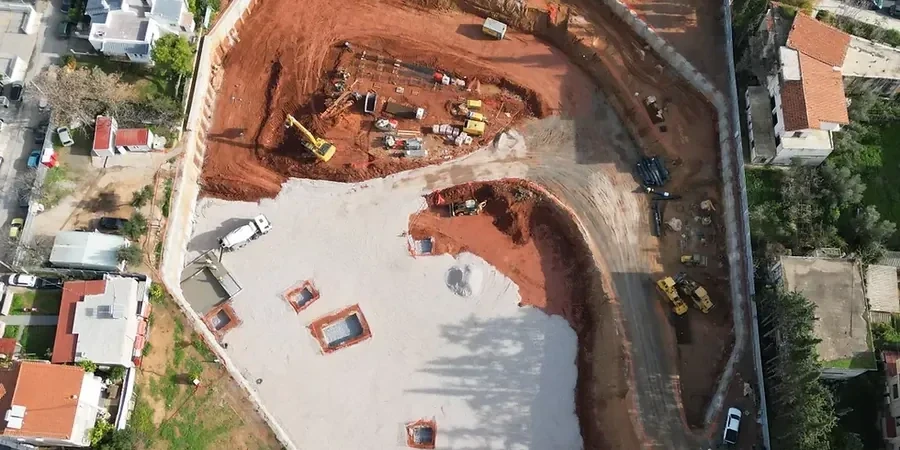
A contractor recently opened a four-level basement on St Georges Terrace, right next to a 1920s masonry building. The excavation reached 14 metres into the Bassendean Sand, with the water table sitting at just 4 metres below the pavement. Designing that temporary retention system was not about picking a standard sheet pile section from a catalogue. It was about understanding how loose, saturated sands lose effective stress under vibration from nearby traffic, and how a single misjudged dewatering drawdown could trigger settlement cracks in the heritage facade. In Perth, deep excavation design is driven by the geology of the Swan Coastal Plain and by the reality that every basement is a neighbour to something fragile. We combine site-specific geotechnical models with structural analysis of propped and anchored walls to deliver designs that keep the dig stable and the street intact. Early ground characterization through CPT testing lets us map the transition from the superficial dune sands into the Guildford Clay with the precision that staged excavation demands.
In Perth, a deep excavation design is a groundwater management plan as much as it is a structural scheme.
Approach and scope
Local geotechnical context
The most common call we get from builders is about water coming through the base of a shored excavation in Northbridge or East Perth. The Bassendean Sand can hold a steep face temporarily, but once groundwater flow concentrates at the toe, the passive resistance vanishes quickly. We have seen excavations where a 300 mm uncontrolled inflow washed out enough fines to drop a neighbouring pavement by 40 mm overnight. The risk is not just collapse: it is the cost of emergency backfill, council stop-work orders, and insurance claims from affected property owners. Our designs include mandatory observation triggers. If the piezometer reading exceeds the threshold defined in the excavation monitoring plan, the contractor knows exactly which contingency measure to activate, whether it is additional dewatering wells, a toe berm, or a switch from open-cut to a strutted system. In Perth's sandy profile, the margin between a dry cut and a blowout is often a single metre of hydraulic head.
Relevant standards
AS 4678-2002 Earth-retaining structures, AS 1726-2017 Geotechnical site investigations, AS/NZS 1170.0:2002 Structural design actions – General principles, AS 1170.4-2007 Earthquake actions in Australia, AS 2159-2009 Piling – Design and installation, AS 3798-2007 Guidelines on earthworks
Related technical services
Temporary and permanent retention design
We design contiguous bored pile walls, secant pile walls, and diaphragm walls for basements, cut-and-cover tunnels, and pump stations. Each design includes a staged excavation sequence, strut or anchor layout, and a dewatering specification aligned with the Department of Water and Environmental Regulation requirements.
Excavation monitoring and peer review
We install and interpret inclinometers, piezometers, and survey targets to track wall deflection and groundwater drawdown during construction. The data feeds back into the design model, allowing real-time adjustment of strut preloads or excavation steps. We also provide independent peer review for designs prepared by others, verifying compliance with AS 4678 and project-specific performance criteria.
Typical parameters
Top questions
What is the typical cost of a deep excavation design for a Perth basement project?
For a typical Perth basement excavation in the 8 to 15 metre depth range, the geotechnical design package generally falls between AU$3,510 and AU$13,620, depending on the complexity of the ground profile, the number of retained faces adjacent to existing structures, and whether groundwater modelling is required. Projects that need 3D finite element analysis or staged construction simulation sit at the upper end of that range.
How do you handle groundwater in Perth's sandy soil during deep excavation?
Groundwater control in the Bassendean Sand typically relies on a combination of deep well dewatering outside the excavation footprint and recharge trenches to protect neighbouring buildings from settlement. We model the aquifer response using site-specific permeability values from in-situ tests, then specify pump rates, well spacing, and cut-off depths. The design always includes a contingency for the artesian conditions that occasionally appear where the Guildford Clay forms a confining layer below the sand.
What retention system works best for a deep excavation next to an existing building in Perth?
The choice depends on the depth, the condition of the adjacent foundation, and the allowable deflection. In the Perth CBD, we frequently specify secant pile walls because they provide both groundwater cut-off and stiffness against lateral movement. Where the excavation is within a few metres of a sensitive structure, we add a row of preloaded anchors or internal struts at mid-height to limit wall deflection to less than 0.2 percent of the excavation depth, which protects the neighbouring building from differential settlement.