One of the most expensive mistakes we see in Perth’s construction sector is designing a foundation as if the ground is solid, only to discover during a seismic event that the saturated sands of the Swan Coastal Plain have turned to slurry. It is an assumption that has led to structural tilting and complete foundation failure in other parts of the world, yet it remains underappreciated locally. Our laboratory team runs soil liquefaction analysis not as a theoretical exercise, but as a practical, data-driven process grounded in AS 1726 and the NCEER workshop procedures. We correlate corrected SPT blow counts from our spt drilling rigs with fines content from grain size tests to calculate a defensible factor of safety against liquefaction for your project’s design earthquake, providing engineers with clear go/no-go thresholds.
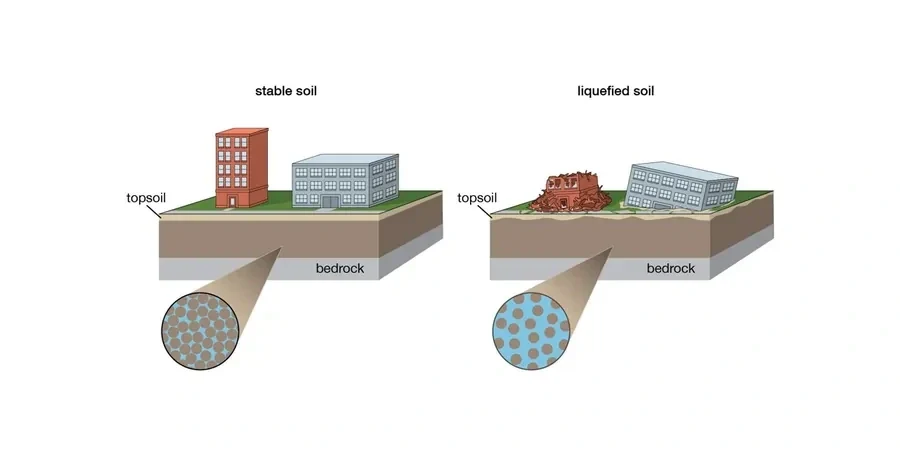
Liquefaction does not require a massive earthquake—just enough cyclic loading in loose, saturated sand to collapse the soil skeleton and transfer stress to the pore water.
Approach and scope
- Field investigation using SPT and cpt testing to capture penetration resistance without sample disturbance
- Laboratory determination of Atterberg limits and fines content to apply the appropriate correction factors to the cyclic resistance ratio
- Magnitude scaling factors derived from the specific seismic source contributing most to the hazard at the site
Local geotechnical context
A practical observation from our Perth projects: many boreholes stop at the refusal depth for the foundation, but liquefaction assessment demands characterization of the entire saturated sand column—often down to 20 metres or more. Stopping at 6 metres because that is where the piles will bear misses the layer at 11 metres that can liquefy first, causing lateral spreading that shears the pile shaft. We also see contractors misinterpreting dense sand at the surface as indicative of the entire profile. In the Swan Coastal Plain, a dense crust over loose, saturated sand is common, and that crust does nothing to prevent liquefaction at depth. The risk is a sudden loss of skin friction and end bearing, a mechanism that standard bearing capacity checks will never catch unless a site-specific liquefaction analysis is on the table from day one.
Relevant standards
AS 1726:2017 (Geotechnical site investigations), AS 4678:2002 (Earth-retaining structures, for post-liquefaction lateral spread), NCEER Workshop (1996/2001) procedures for SPT-based liquefaction triggering, AS 1170.4:2007 (Earthquake actions in Australia)
Related technical services
SPT-Based Liquefaction Triggering
We execute and log SPT tests with calibrated hammers, applying energy corrections (ER/60) and overburden corrections to derive clean-sand-equivalent blow counts, then process the data through the Seed-Idriss simplified procedure to obtain a factor of safety at each test depth.
CPT-Based Continuous Profiling
Using piezocone data, we map the soil behaviour type index (Ic) and calculate the cyclic resistance ratio at millimetric intervals, which is particularly useful for detecting thin liquefiable seams that SPT intervals might miss in Perth’s alluvial deposits.
Post-Liquefaction Settlement & Lateral Spread
We estimate volumetric strain from the factor of safety and relative density, providing the geotechnical designer with expected ground surface settlements and lateral displacement demands on deep foundations and retaining walls.
Typical parameters
Top questions
What does a liquefaction analysis typically cost for a residential block in Perth?
For a standard residential site on the Swan Coastal Plain, a complete soil liquefaction analysis including SPT drilling, laboratory classification, and the engineering report typically ranges from AU$3.420 to AU$6.760. The final cost depends on the number of boreholes, the depth of investigation required to penetrate the full saturated sand profile, and whether supplementary CPT profiling is needed to resolve thin layers.
How deep do you need to investigate for liquefaction in the Perth metro area?
We generally investigate to at least 20 metres below ground surface, or until a competent bearing stratum is encountered with consistently high SPT N-values and low susceptibility. In areas like the Bassendean Sand formation, liquefiable layers can be present well below the typical 5–8 metre foundation target depth, and missing them leads to an unconservative design.
Is Perth really seismically active enough to need liquefaction analysis?
The short answer is yes. While Western Australia is not on a plate boundary, the South West Seismic Zone has produced damaging events like the 1968 Meckering earthquake (Mw 6.5). AS 1170.4 assigns a hazard factor to Perth, and when combined with the widespread loose, saturated sandy soils, the probability of liquefaction triggering at least once in a structure’s design life is not negligible for Importance Level 3 and 4 buildings.