In the geotechnical landscape of Perth, Western Australia, the laboratory testing category forms the backbone of every defensible site investigation and foundation design. It moves beyond field observations and borehole logs to deliver quantified, repeatable data on soil and rock behaviour under controlled conditions. For engineers and contractors operating across the Swan Coastal Plain, laboratory testing is not merely a compliance checkbox—it is the critical bridge between subsurface uncertainty and safe, economical construction. Without this data, assumptions about bearing capacity, settlement potential, or excavation stability remain speculative at best.
Perth's geology presents a unique set of challenges that make rigorous laboratory work indispensable. Much of the metropolitan area sits on the Bassendean and Spearwood dune systems, characterised by deep, variably cemented sands with occasional limestone caprock and interbedded clay lenses. The Guildford Formation, with its stiff, overconsolidated clays and silts, introduces shrink-swell hazards that demand precise classification through tests like Atterberg limits. Similarly, the alluvial deposits along the Swan and Canning Rivers often contain soft, compressible layers requiring careful assessment of consolidation parameters. Even the ubiquitous sandy soils, while visually uniform, can exhibit vastly different engineering properties depending on their relative density, fines content, and particle angularity—all of which are resolved through a comprehensive laboratory programme.
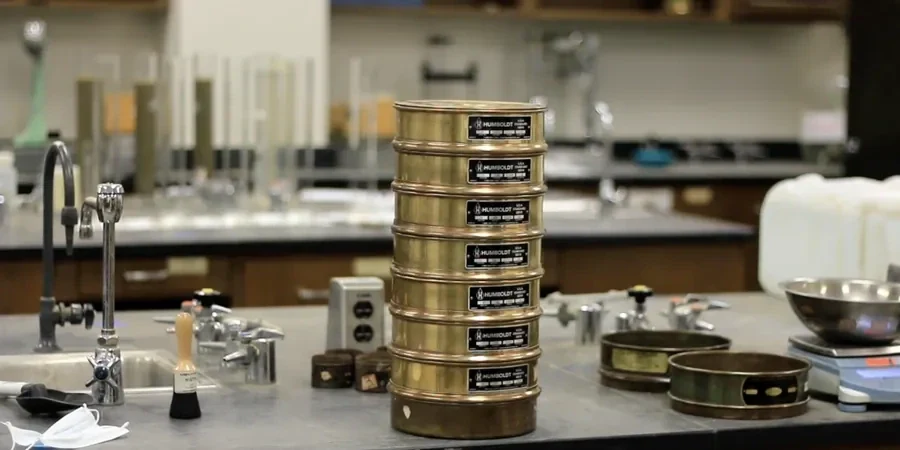
Compliance with Australian Standards governs every procedure within the Perth laboratory environment. AS 1289, the multi-part standard for soil testing methods, is the primary reference, dictating everything from sample preparation to the specific apparatus used for each test. For instance, AS 1289.3.6.1 specifies the dry sieving method for particle size distribution, while AS 1289.3.5.1 covers the hydrometer analysis for finer fractions, both of which are combined in a full grain size analysis (sieve + hydrometer). AS 1289.3.4.1 and 3.3.1 detail the liquid and plastic limit determinations. NATA accreditation of the testing facility, as required by many local council and Main Roads Western Australia specifications, ensures that these standards are applied with demonstrable technical competence and impartiality, giving stakeholders confidence in the results.
The types of projects that demand laboratory testing in Perth span the full spectrum of civil and commercial development. Residential subdivisions on reactive clay sites cannot proceed without Atterberg limits to classify the site according to AS 2870, the residential slab and footing standard. High-rise developments on deep sand profiles rely on particle size distribution curves and shear strength tests to inform deep foundation design, such as bored piles socketed into the Kings Park Formation. Infrastructure projects, from the METRONET rail expansions to major highway upgrades, require extensive laboratory characterisation of imported fill, subgrade materials, and concrete aggregates. Even environmental site assessments for brownfield redevelopment depend on laboratory analysis to delineate contamination and assess the geotechnical viability of the ground.
Common questions
Why is laboratory testing essential for geotechnical projects in Perth?
Laboratory testing quantifies the physical and mechanical properties of Perth's diverse soils—from Bassendean sands to Guildford clays—under controlled conditions. This data is essential for accurate foundation design, assessing shrink-swell potential, and ensuring compliance with Australian Standards like AS 1289 and AS 2870, ultimately reducing the risk of structural distress in the local sandy and reactive clay environments.
What Australian Standards govern geotechnical laboratory testing in Western Australia?
The primary standard is the AS 1289 series, which specifies methods for soil classification, compaction, strength, and consolidation tests. For residential slabs on reactive clays, AS 2870 references specific laboratory tests to classify site reactivity. NATA accreditation ensures laboratories meet these standards with technical competence, a requirement commonly stipulated by Main Roads WA and local authorities.
How do I know which laboratory tests my Perth project requires?
The required tests depend on the soil profile encountered during drilling and the project's scope. A typical programme starts with index tests like particle size distribution and Atterberg limits for classification. Engineering tests, such as direct shear, consolidation, or California Bearing Ratio (CBR), are then selected by the geotechnical engineer based on the specific loading conditions and design requirements of the structure.
What is the difference between index tests and performance tests in a geotechnical laboratory?
Index tests, such as moisture content, grain size analysis, and Atterberg limits, classify soil into groups with broadly predictable behaviour. Performance tests, including triaxial shear, consolidation, and CBR, measure specific engineering properties like shear strength, compressibility, and bearing capacity under simulated field conditions, providing direct design parameters for the project.