Perth sits on a complex sedimentary stack that challenges deep foundation design. The Swan Coastal Plain exposes Bassendean Sand over Guildford Formation clays, with Tamala Limestone outcropping along the coast. Groundwater is often within 2–4 metres of surface across the metropolitan area. These conditions demand pile design that accounts for low skin friction in saturated sands, potential negative skin friction in alluvial clays, and variable rock socket behaviour in calcarenite. Our NATA-accredited geomechanics laboratory runs consolidated-undrained triaxial tests and direct shear on undisturbed samples to feed accurate parameters into the analysis. We use AS 2159-2009 for geotechnical strength reduction and AS 3600 for structural design of reinforced concrete piles. Load-transfer curves are calibrated against CPT data when CPT testing is performed on-site, providing a continuous profile of tip resistance and sleeve friction.
A pile in Perth is not a generic element—it must be designed for the specific Bassendean Sand, Guildford Clay, and Tamala Limestone sequence.
Approach and scope
Local geotechnical context
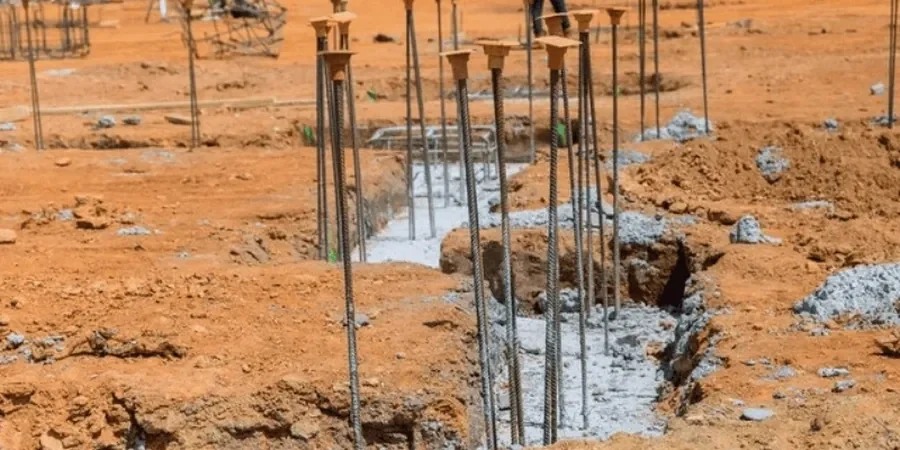
Perth’s post-war expansion spread from the river flats onto deep sand deposits and reclaimed swamplands without uniform geotechnical regulation. Today, redevelopment of those same lots reveals uncontrolled fill, buried organic material, and variable groundwater chemistry that accelerates concrete degradation. A pile foundation designed without site-specific investigation can encounter soft layers that were never mapped on regional geological sheets. Sulfate-rich groundwater in the Guildford Formation attacks ordinary Portland cement, requiring sulfate-resisting cement or sacrificial steel thickness. Karst voids in Tamala Limestone have caused sudden loss of drilling fluid circulation and, in rare cases, pile tip collapse during construction. Our design reports include a ground risk register that identifies each of these hazards per borehole, specifying mitigation measures—pre-drilling through limestone, permanent casing through aggressive water, and pile load testing to verify design assumptions.
Relevant standards
AS 2159-2009: Piling — Design and installation, AS 3600-2018: Concrete structures, AS 1726-2017: Geotechnical site investigations, AS 4678-2002: Earth-retaining structures (relevant for lateral pile analysis), AS/NZS 1170.0:2002: Structural design actions
Related technical services
Axial capacity design (compression and tension)
We compute ultimate and serviceability limit state capacities using the modified β-method for sand and the α-method for clay, calibrated against site-specific CPT and laboratory strength tests.
Lateral response and p-y analysis
We model pile-soil interaction under seismic and wind loads using p-y springs per Reese and Matlock, with soil parameters derived from consolidated-undrained triaxial and direct shear testing.
Pile load test specification and interpretation
We prepare static and dynamic load test specifications in accordance with AS 2159 Appendix A, and back-analyze results to refine the geotechnical design model before production piling.
Typical parameters
Top questions
What is the typical cost range for pile foundation design for a residential project in Perth?
For a standard single-dwelling residential project in the Perth metro area, pile foundation design fees typically range from AU$2.790 to AU$10.570, depending on the number of piles, the complexity of the ground profile, and the required level of load testing.
Which AS 2159 design method do you use for Perth sands?
We apply the modified β-method for shaft friction in Bassendean Sand, using effective stress parameters calibrated to site-specific CPT data and consolidated-drained triaxial tests. This approach accounts for the low in-situ density and installation effects of bored versus driven piles.
How do you handle karstic conditions in Tamala Limestone?
We specify pre-drilling or probing ahead of pile installation to detect cavities, design rock sockets to span potential voids, and use permanent steel casing through the limestone where dissolution features are extensive. Load-transfer curves are truncated at cavity intervals.
What laboratory tests do you require before designing a pile?
We typically require Atterberg limits, particle size distribution, consolidated-undrained triaxial with pore pressure measurement, oedometer consolidation tests for clay layers, and point load index testing for rock sockets. All testing is performed in our NATA-accredited laboratory.