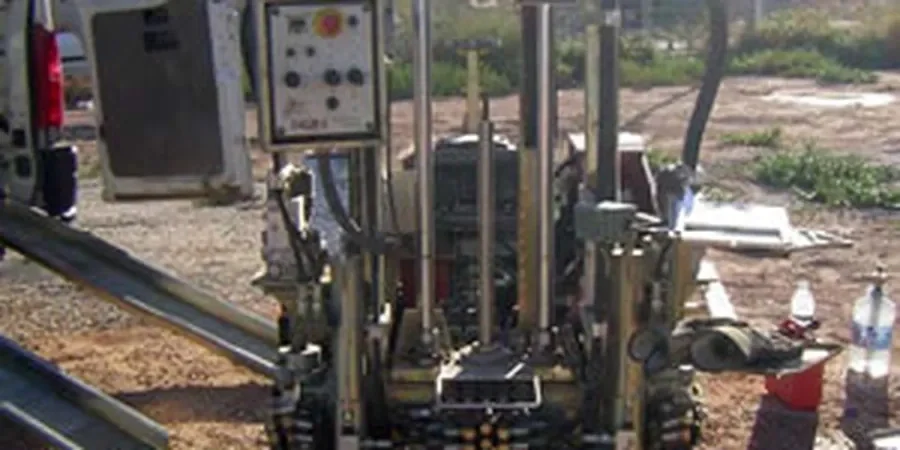
A 20-tonne CPT crawler rig moves into position on a site in Osborne Park. The hydraulic rams engage and a 15 cm² cone on a string of rods begins its push into the ground at a constant 20 mm per second. In Perth this is how we map the subsurface when boreholes are too slow and disturbed samples won't cut it. The Swan Coastal Plain geology across the metro area — from Butler to Mandurah — presents layers of Tamala Limestone, Bassendean Sand, and Guildford Formation clay that demand continuous, high-resolution profiling. Standard penetration tests often miss thin lenses of soft clay or loose sand at depth, especially near the Swan River foreshore where alluvial sequences are complex. Our CPT rigs are instrumented with piezocone (CPTu) capability to measure pore pressure during penetration, giving us a direct read on drainage conditions and soil behaviour type from the Robertson chart in real time.
Three channels of continuous data every 10 mm: qc, fs, and u2 — processed in real time to classify soil behaviour type without a single disturbed sample.
Approach and scope
Local geotechnical context
Perth recorded a magnitude 6.5 earthquake at Meckering in 1968, and while the metro area has lower seismicity than the eastern states, AS 1170.4 still assigns hazard factors that influence site classification. The bigger risk here is liquefaction. Loose, saturated Bassendean Sand layers below the water table — common in suburbs like Bayswater and Bassendean itself — can lose strength under cyclic loading. A CPT profile gives us the data to run a Boulanger and Idriss (2014) liquefaction triggering analysis directly, without converting SPT blow counts and losing resolution. When the cone tip resistance drops below 5 MPa and the friction ratio sits under 1%, we flag the layer immediately. For sites near the Swan River or coastal dunes, the CPT also picks up the depth to groundwater and the thickness of any potentially collapsible sand above it. Skipping this profile means designing on assumptions, and assumptions in Perth's variable geology have a habit of surfacing as differential settlement two years after handover.
Service video
Relevant standards
AS 1726:2017 – Geotechnical site investigations, AS/NZS 1170.4:2007 – Earthquake actions in Australia, Boulanger & Idriss (2014) – CPT-based liquefaction triggering, Robertson (2016) – Soil behaviour type classification from CPTu
Related technical services
CPTu with pore pressure measurement
Standard piezocone testing with saturated filter element. We measure qc, fs, and u2 simultaneously at 10 mm intervals. Real-time soil behaviour type classification during penetration.
Seismic CPT (SCPTu) for Vs profiling
Downhole geophone array on the cone string captures shear wave velocity at 1 m depth intervals. Used for AS 1170.4 site classification and liquefaction assessment where Vs-based methods complement CPT-based triggering analysis.
Dissipation tests and groundwater profiling
Pore pressure dissipation tests at target depths to estimate coefficient of consolidation in clays and silts. We also log hydrostatic profile and identify perched water tables in layered Perth Basin sediments.
Typical parameters
Top questions
How deep can a CPT rig penetrate in Perth soils?
In the Bassendean Sand and alluvial deposits across the Swan Coastal Plain, we routinely reach 20 to 25 metres. Refusal occurs when the cone hits cemented Tamala Limestone pinnacles or very dense sand layers, often between 6 and 15 metres in western suburbs like Wembley and City Beach. We log the refusal depth and can switch to rotary drilling to continue the profile through hard bands.
What is the cost of a CPT test in Perth?
CPT testing in Perth typically runs between AU$240 and AU$390 per location for standard-depth residential profiles, depending on access conditions, depth achieved, and whether piezocone or seismic cone is required. Deeper profiles and multi-rig programs on infrastructure sites are quoted based on scope.
Do you need to take soil samples if you run CPT?
CPT is a continuous profiling tool that does not recover physical samples. In Perth we often pair it with one or two boreholes for index testing — Atterberg limits on Guildford Clay or particle size distribution on Bassendean Sand — to calibrate the CPT soil behaviour type classification against laboratory results. This hybrid approach satisfies AS 1726 requirements for most projects.
Can CPT detect limestone pinnacles in Perth's western suburbs?
Yes, and it does so with high precision. When the cone tip encounters a Tamala Limestone pinnacle, tip resistance spikes sharply — often exceeding 50 MPa — and penetration stops within centimetres. By running multiple CPTs on a tight grid, we map the pinnacle distribution across a site and identify areas where pile pre-drilling or alternative foundation solutions will be needed. More info.