Getting the particle size distribution right determines everything from drainage design to compaction specification. In Perth, where the Bassendean Sand and Guildford Clay formations dominate the metro area, a standard AS 1726 grain size analysis isn't just a box-ticking exercise. It tells you whether that sandy layer will drain freely under a stormwater basin or hold moisture against a retaining wall. Our NATA-accredited laboratory runs the full sieve stack plus hydrometer on every sample, so you get a continuous curve from the 75 mm sieve down to the 2-micron clay fraction. For road projects through the Swan Coastal Plain, we often pair this with a CBR test to link the grading curve directly to pavement design values. The hydrometer step takes a full 24 hours, but we process samples in controlled sedimentation cylinders at 20 degrees Celsius, exactly as the standard demands.
A grain size curve isn't a lab souvenir. It's the single most important piece of paper for predicting how water and load will interact with your soil.
Approach and scope
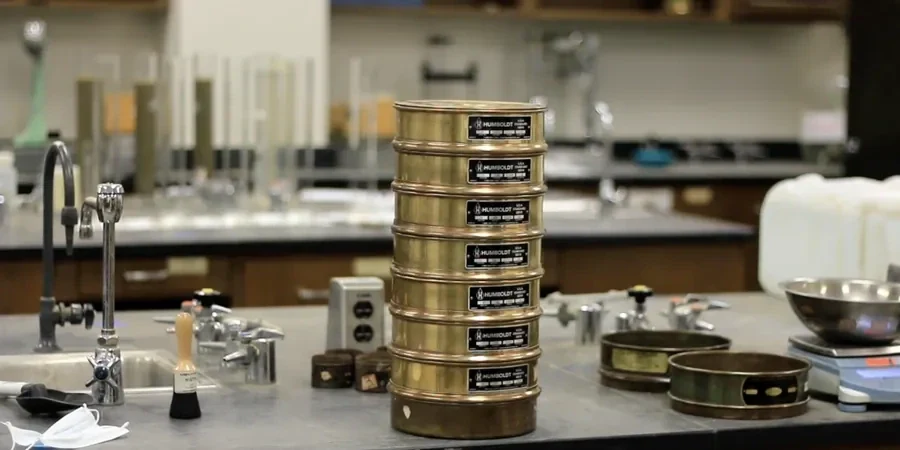
Local geotechnical context
The sedimentation cylinder sits in a constant-temperature water bath at 20 degrees, with hydrometer readings taken at 0.5, 1, 2, 4, 8, 15, 30, 60, 120, 240 and 1440 minutes. Skip a reading at the two-minute mark and you lose the silt-sand boundary definition. In Perth's summer, ambient lab temperatures can drift above 30 degrees, which lowers the fluid viscosity and makes particles settle faster. We run the bath with a circulating chiller, not just a heater, to hold that 20-degree setpoint year-round. A hydrometer reading taken at 26 degrees without correction will overestimate the clay fraction by several percentage points. The meniscus correction gets applied on every single reading, and we log the temperature before and after. When a project involves deep excavations in the Perth CBD, a mischaracterised silt layer can change the dewatering plan entirely. That's why we record raw data sheets, not just the final curve.
Service video
Relevant standards
AS 1726:2017 Geotechnical site investigations, AS 1289.3.6.1:2009 Particle size distribution, AS 1289.3.6.3:2003 Fine particle size distribution (hydrometer)
Related technical services
Standard Sieve Analysis (Coarse Fraction)
Mechanical dry sieving from 75 mm down to 75 micron on washed and oven-dried material. Includes hydrometer on the minus-75-micron fraction when fines exceed 5 percent. Suitable for sand, gravel and crushed rock aggregates across Perth metro projects.
Full Hydrometer Sedimentation Analysis
Complete 24-hour sedimentation test using a 152H hydrometer on the sub-75-micron fraction. Delivers a continuous grading curve down to 2 microns. Essential for clay-rich soils in the Guildford and Kings Park formations where the fines fraction controls permeability and shrink-swell behaviour.
Typical parameters
Top questions
What does a grain size analysis cost in Perth?
For a combined sieve and hydrometer test, standard pricing runs between AU$160 and AU$290 per sample depending on whether we're doing just the coarse fraction or the full sedimentation run. Express 48-hour turnaround adds a small surcharge. Volume discounts apply for five or more samples from the same site.
How long does the hydrometer part take?
The full hydrometer sedimentation test takes 24 hours from the moment the cylinder is shaken. We take readings at specified intervals over that period. The coarse sieve portion can be completed the same day. A standard combined report is ready in three to five working days.
Do I need the hydrometer if my soil looks sandy?
If your sample is from a Perth coastal plain site, it might look like clean sand. But even 5 percent fines can drastically change permeability and compaction behaviour. We always run a wash-through first. If the wash-through catches more than 5 percent passing the 75-micron sieve, the hydrometer is strongly recommended. The Bassendean Sand often carries a silt fraction that the eye misses.
What sample size do you need for a full analysis?
For a combined sieve and hydrometer test on typical Perth sands and silts, we need about 500 grams of material. If the soil contains gravel or cobbles, we need more — up to 5 kilograms for material with particles over 20 mm. The sample should be bagged in a sealed plastic bag to preserve the natural moisture content if we're also running moisture-condition-based tests alongside the grading.