A recent residential subdivision in the Swan Valley hit a snag when trench backfill over newly laid services showed settlement within weeks of compaction. The contractor had relied solely on visual inspection and a few random nuclear gauge readings that turned out to be poorly calibrated for the local Guildford clay. The issue was resolved only after switching to the sand cone method—an elegant, low-tech procedure that remains the referee test when disputes arise. In Perth, where site geology can swing from Bassendean sand to lateritic duricrust within a single lot, the sand cone field density test offers a definitive, calibration-free measurement of in-place density. It serves as the benchmark for compaction verification under [AS 1289.5.3.1](https://www.standards.org.au) and is routinely specified by geotechnical engineers for road sub-base, structural fill, and utility trench reinstatement across the metropolitan area.
The sand cone method remains the referee for compaction disputes because it measures volume directly—no calibration curves, no radiation source, just mass and geometry.
Approach and scope
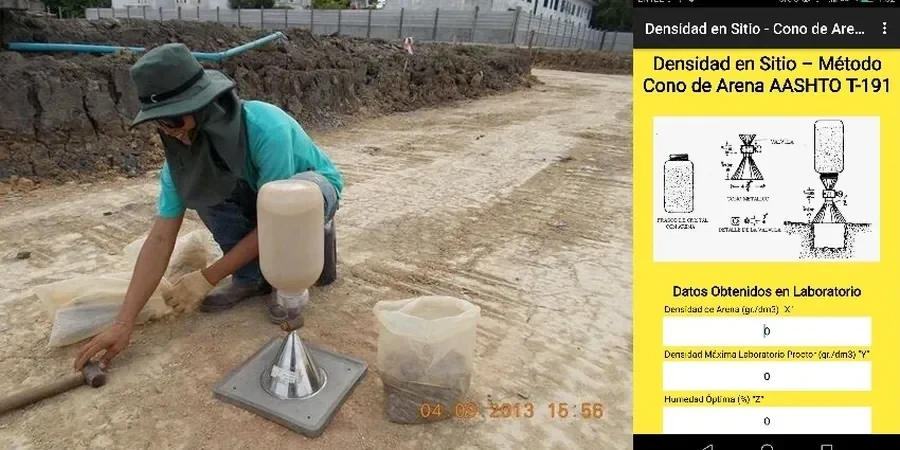
Local geotechnical context
Perth sits at approximately 32 metres above mean sea level on the Swan Coastal Plain, with much of the urban footprint built on Quaternary dune sands that are notoriously difficult to compact uniformly. When field density verification is skipped or performed with uncalibrated nuclear gauges on these sands, the consequences surface quickly: differential settlement beneath slab-on-ground foundations, cracking in flexible pavements, and water ingress through poorly compacted utility trench backfill. A 2022 audit of residential earthworks in the City of Wanneroo found that nearly one in five lots exhibited post-construction subsidence where sand cone testing had not been used as the primary acceptance tool. The method's strength lies in its direct volume measurement—there is no reliance on backscatter correlations that drift with soil chemistry—making it the contractual fallback test in most Perth infrastructure specifications. For fills placed over the Guildford Formation clays, where moisture control during compaction is critical, the sand cone's companion moisture content determination provides an early warning against placing material wet of optimum, which is the fastest path to long-term settlement.
Relevant standards
AS 1289.5.3.1 – Soil compaction and density tests: Determination of the field density of a soil – Sand replacement method using a sand-cone pouring apparatus, AS 1289.2.1.1 – Moisture content of a soil: Oven drying method (standard method), AS 3798 – Guidelines on earthworks for commercial and residential developments, Main Roads WA Specification 302 – Earthworks
Related technical services
Compaction control for structural fill
Sand cone density testing on building platforms, retaining wall backfill, and basement excavations across Perth's metropolitan area. We test at the frequency required by AS 3798 and provide same-day dry density ratios.
Road and pavement sub-base verification
Field density checks on crushed rock base, limestone sub-base, and select fill layers prior to asphalt or concrete paving. Main Roads WA specification compliance included as standard.
Trench reinstatement and service backfill
Post-compaction verification for utility trenches, stormwater drainage alignments, and sewer lines. We coordinate with Water Corporation and local council inspection requirements in real time.
Typical parameters
Top questions
What does a sand cone field density test cost in Perth?
For a standard test with moisture content determination and a NATA-endorsed report, pricing typically falls between AU$170 and AU$260 per test location, depending on site access, number of tests per day, and travel distance within the Perth metropolitan area. Large-volume earthworks programs attract reduced per-test rates.
How does the sand cone method compare to a nuclear gauge?
The sand cone method measures volume directly by replacing the excavated soil with a calibrated sand of known bulk density, so it requires no correlation curves or radiation safety protocols. Nuclear gauges are faster but can drift with soil chemistry—particularly in Perth's iron-rich laterites—and must be calibrated against a sand cone reference regularly. Most Main Roads WA specifications designate the sand cone as the referee test when nuclear gauge results are disputed.
How many tests do I need for a residential slab in Perth?
AS 3798 recommends a minimum frequency of one field density test per material type per 500 m² of each compacted layer, or at least one test per lot for residential subdivisions. On Perth's sandy sites, where fill thickness rarely exceeds 600 mm, a single test per layer per lot is common, but the supervising geotechnical engineer may increase frequency around service penetrations or cut-and-fill transitions.
Can the sand cone test be used on crushed rock with large particles?
Yes, but the test hole volume must be increased—typically to at least 1,400 cm³—to accommodate the larger particle size. For material with significant oversize rock, a correction is applied following AS 1289.5.4.1, and we often run a companion grain size distribution to quantify the percentage retained on the 19 mm or 37.5 mm sieve.
How soon after compaction can you test?
The test can be performed immediately after the final roller pass, provided the surface is firm enough to support the sand cone base plate without deformation. We typically schedule testing within the same shift as compaction to avoid moisture loss from Perth's afternoon easterly winds, which can artificially lower the field moisture content and inflate the dry density ratio. More info.