Perth sits on the Swan Coastal Plain, a deep sedimentary basin that amplifies long-period ground motion. The sands and clays of the Bassendean and Guildford formations are not uniform. A site class that looks stable on paper can shift dramatically once depth to bedrock and Vs30 are measured. AS 1170.4 requires a site-specific seismic microzonation study for any structure taller than three storeys in this region. We run MASW surveys and downhole testing to define the shear wave velocity profile, then combine that data with AS 1726 borehole logs to map shaking potential across the site. For projects near the Darling Scarp, we also integrate seismic refraction lines to capture the abrupt change from shallow rock to deep basin sediments.
A single Vs30 value averaged across a large site masks the pockets of deep sand that control the seismic demand in Perth's eastern suburbs.
Approach and scope
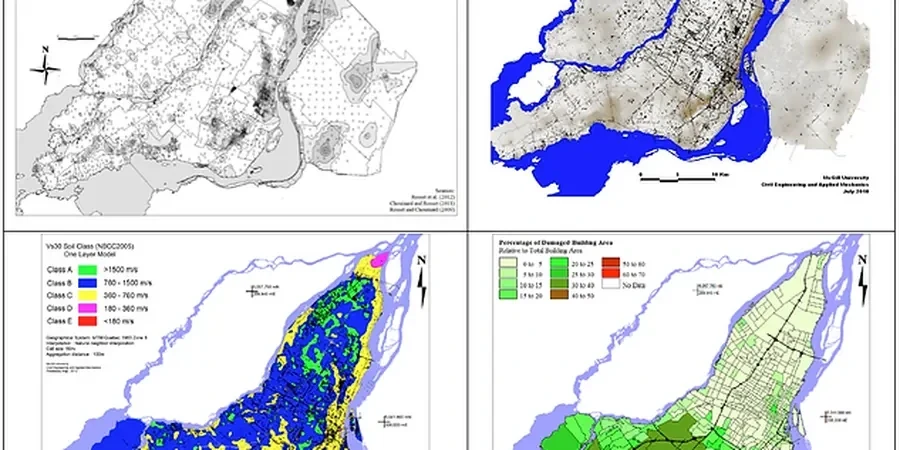
Local geotechnical context
AS 1170.4 Section 3.1 requires site classification for any building in a designated hazard area. Perth is not a high-seismicity city, but the basin effect generates amplification factors of 2.0 to 2.5 over rock at periods near 1 second—right where mid-rise buildings resonate. Ignoring microzonation means defaulting to Site Class Be, which can underestimate spectral demand by 40 percent or more on deep sand sites. That error flows directly into the structural design: smaller columns, lighter reinforcement, and a building that does not meet the life-safety performance objective. For schools, hospitals, and emergency response facilities, the post-disaster importance level amplifies the hazard further. A site-specific seismic microzonation study removes the guesswork and gives the structural engineer a defensible basis for the earthquake load case.
Relevant standards
AS 1170.4:2007 (R2018) – Earthquake actions in Australia, AS 1726:2017 – Geotechnical site investigations, AS/NZS 1170.0:2002 – Structural design actions, General principles, NEHRP site classification (FEMA 450)
Related technical services
Screening-Level Vs30 Map
Active and passive MASW at 20–30 m spacing, 1D Vs profiles, Vs30 map, and site class assignment per AS 1170.4. Suitable for feasibility studies and subdivision master planning.
Full Site Response Analysis
Calibrated shear wave velocity profiles with downhole or crosshole verification, laboratory dynamic testing (resonant column, cyclic triaxial), and 1D equivalent-linear or nonlinear site response modeling. Required for Performance-Based Design and tall buildings.
Typical parameters
Top questions
How much does a seismic microzonation study cost in Perth?
A screening-level MASW survey across a typical residential subdivision ranges from AU$7,170 to AU$12,500 depending on the number of measurement points. A full site response analysis with downhole calibration and laboratory dynamic testing runs between AU$15,800 and AU$22,870. We provide a fixed-price proposal after reviewing the site plan and the structural engineer's requirements.
What is the minimum number of MASW points needed for a reliable microzonation map?
AS 1170.4 does not specify a minimum, but the NEHRP guidelines recommend at least one Vs30 measurement per 2,500 m² for Site Class C and D soils. In Perth's variable Bassendean sands we typically use one point per 1,500 m² to capture lateral changes, and we verify with at least one CPT or borehole per 5,000 m².
Do I need a microzonation study for a single house in Perth?
For a single Class 1a dwelling, AS 1170.4 does not mandate site-specific microzonation unless the site is on deep soft soil (Site Class D or E) and the hazard factor Z exceeds 0.08. Most Perth residential sites classify as Ce or De. If the geotechnical investigation flags more than 15 metres of loose sand with groundwater within 3 metres, we recommend at least a Vs30 measurement to confirm the site class before finalising the footing design.