With Perth's population pushing past 2.1 million and the metro area stretching 150 kilometers along the Swan Coastal Plain, the demand for durable transport infrastructure keeps climbing. Rigid pavement design here isn't just a matter of specifying a concrete thickness—it's a response to the region's notorious sandy soils, seasonal groundwater shifts, and summer temperatures that routinely exceed 40 degrees Celsius. The Bassendean Sand and Spearwood Dune systems that underlie much of the metropolitan area present variable bearing conditions, and when you combine that with the alkalescence of local aggregates, the risk of alkali-silica reaction becomes a real design parameter. A proper rigid pavement design for Perth conditions integrates the subgrade modulus from on-site testing, anticipated traffic loading per Austroads, and thermal gradient analysis to prevent uncontrolled cracking. In corridors like Tonkin Highway or the Mitchell Freeway extension, this level of analysis has proven essential to achieving the 40-year design life that Main Roads Western Australia expects.
In Perth's Spearwood Dune sands, the modulus of subgrade reaction can vary by 40% within a single lot—plate load tests at design spacing are not optional.
Approach and scope
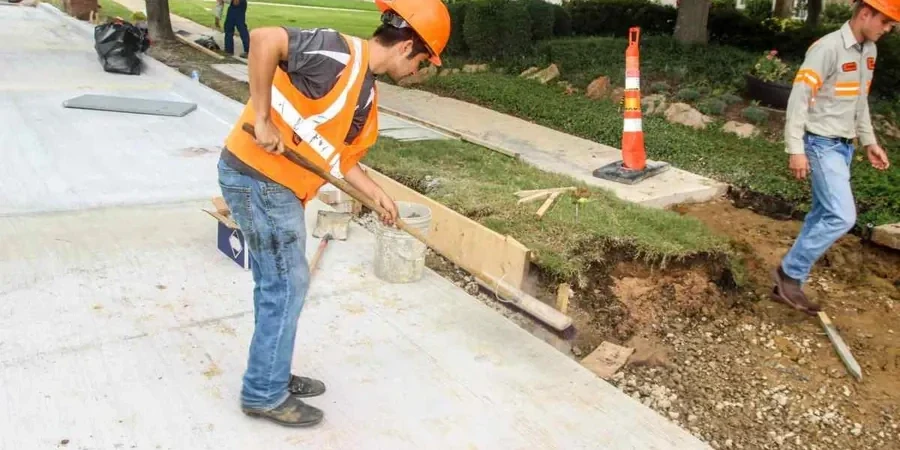
Local geotechnical context
The team deploys a trailer-mounted static plate load test rig with a 760 mm diameter bearing plate, positioned at subgrade level after trimming. The test runs through a series of load increments up to 0.14 MPa, held for settlement readings that feed directly into the k-value calculation. In Perth's sandy terrain, the biggest risk to a rigid pavement design isn't structural failure under traffic—it's moisture-induced loss of subgrade support at the slab edges. When winter rains saturate the shoulder material and the water can't drain through the dense limestone caprock present in much of the western suburbs, the base course turns into a slurry over a few wet weeks. The resulting loss of edge support concentrates bending stresses that the slab's longitudinal steel wasn't designed to handle. A secondary risk emerges where the pavement transitions from cut to fill sections: differential settlement between the undisturbed Spearwood Sand and the compacted fill creates a hinge point that concentrates load transfer stresses at the contraction joint, eventually causing faulting.
Relevant standards
Austroads Guide to Pavement Technology Part 2: Pavement Structural Design (AGPT02-24), AS 3727.1:2016 Guide to residential pavements, Part 1: Concrete, Main Roads WA Specification 501 Pavements, AS 1379:2007 Specification and supply of concrete
Related technical services
Subgrade Reaction Modulus Testing
Static plate load tests (AS 1289.6.7.1) conducted at formation level to determine the Westergaard k-value. Testing follows a grid pattern matched to the pavement panel layout, capturing the spatial variability of Perth's sandy profiles.
Concrete Mix Design and Durability Review
Evaluation of local aggregate reactivity, grading, and chloride exposure class per AS 1379. Includes shrinkage testing and thermal expansion coefficient determination for joint design in Perth's summer conditions.
Jointing and Reinforcement Plan
Detailed layout of contraction, expansion, and construction joints coordinated with the structural design. Tie bar and dowel bar sizing based on Westergaard edge loading analysis, adapted for the diurnal thermal cycle.
Typical parameters
Top questions
How does Perth's sandy subgrade affect rigid pavement design compared to clay soils?
Sandy soils like Perth's Bassendean Sand provide a relatively uniform but lower k-value than stiff clays, typically in the range of 40 to 80 MPa/m unless stabilized. The main implication is that slab curling under thermal gradients becomes the critical load case rather than traffic-induced flexure. This means joint spacing and slab thickness are often governed by the positive temperature gradient during a summer afternoon, not by the axle load repetition. Additionally, sand offers excellent internal drainage, so moisture-related warping is less pronounced—but edge support loss during wet winter months still needs to be managed through adequate base course drainage and shoulder sealing.
What is the typical cost range for a rigid pavement design package in Perth?
For a standard arterial road or industrial pavement project in the Perth metro area, a complete rigid pavement design package—covering subgrade investigation, plate load testing, concrete mix design review, and the jointing plan—generally falls between AU$2,500 and AU$8,660. The final cost depends on the number of test locations, the traffic loading class, and whether specialized durability assessments for coastal exposure or ASR mitigation are required.
Which Australian standards govern concrete pavement joint design?
Joint design for rigid pavements in Australia is primarily guided by Austroads AGPT02-24, which provides nomographs for joint spacing, dowel sizing, and tie bar requirements based on slab thickness and lane width. AS 3727.1:2016 covers jointing for residential and light-duty pavements. Main Roads Western Australia Specification 501 adds local requirements for dowel alignment tolerances and joint sealant types suited to Perth's UV exposure and temperature range. The Westergaard equations for curling stress and load transfer efficiency remain the analytical foundation behind the standard recommendations. More info.