A deep vibrator, typically an electric or hydraulic V23 or V32 unit, descends into the granular profile on the Swan Coastal Plain, releasing bursts of water or air to reduce friction as it penetrates. In Perth, where much of the metropolitan area sits atop the Tamala Limestone and overlying Bassendean sand dune deposits, the design of vibrocompaction programs must account for the distinct transition from Holocene sands to Pleistocene calcarenite at depth. The procedure, governed by AS 1726 for site investigation and AS 4678 for earth-retaining structures, requires a detailed preliminary analysis of grain-size distribution and relative density to define grid spacing and probe energy. The sand cone density test provides critical in-situ density benchmarks before and after treatment, while CPT testing delivers a continuous profile of tip resistance to calibrate the target depth and verify that loose layers have been adequately densified.
On the Swan Coastal Plain, leaving loose Bassendean sands untreated invites differential settlement exceeding 25 millimetres under a standard slab-on-ground, a condition vibrocompaction design directly mitigates.
Approach and scope
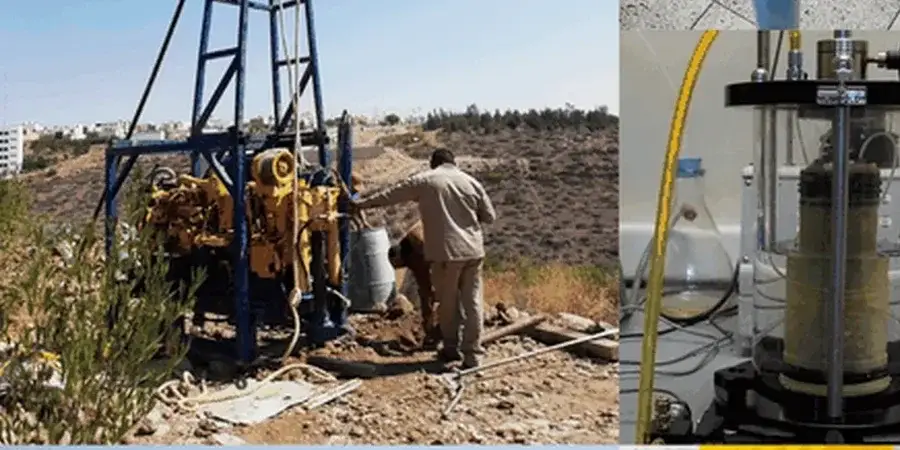
Local geotechnical context
AS 4678 and the AS/NZS 1170 series define the structural and seismic loads that must be considered for Perth, where the design earthquake for a 500-year return period typically yields a peak ground acceleration around 0.09g on rock. On the loose Spearwood sands, amplification factors can push surface accelerations beyond 0.15g, raising the risk of cyclic mobility if vibrocompaction is omitted or poorly executed. The specific hazard in Perth is not high-magnitude crustal rupture but rather the potential for sand boils and lateral spread along the Swan River foreshore and in reclaimed areas near Elizabeth Quay. A liquefaction assessment integrated into the vibrocompaction design quantifies the factor of safety against triggering, using SPT-based correlations from Youd and Idriss (2001) adapted to the local grading of the Bassendean sands.
Relevant standards
AS 1726: Geotechnical Site Investigations, AS 4678: Earth-Retaining Structures, AS/NZS 1170: Structural Design Actions, FHWA-NHI-05-037: Improvement Methods
Related technical services
Pre-Treatment Ground Characterization
Cone penetration tests (CPTu) and borehole sampling across the proposed treatment area to map the thickness of the loose Bassendean sand unit, identify interbedded silty lenses, and confirm the depth to the Tamala Limestone refusal surface.
Vibro Replacement and Stone Column Design
Where fines content exceeds 15 percent and vibrocompaction alone is insufficient, the design transitions to stone columns installed via bottom-feed vibrators, providing both densification and drainage reinforcement for the cohesive matrix.
Post-Treatment Verification Testing
Execution of in-situ density tests, multi-channel surface wave analysis, and repeat CPTu soundings at the centroid of each triangular grid cell to validate that the specified relative density and stiffness have been uniformly achieved.
Typical parameters
Top questions
How is the vibrator grid spacing determined for Perth sand conditions?
Grid spacing depends on the in-situ grain-size curve and the target relative density. For the Bassendean sands, which are typically medium-grained with less than 10 percent fines, a triangular grid of 2.5 to 3.5 metres is standard. The design is refined through a trial zone where three spacings are tested and verified with pre- and post-compaction CPTu soundings to identify the optimum energy input per cubic metre.
What depth can vibrocompaction reach in the Perth metropolitan area?
Effective treatment depth is controlled by the refusal surface, usually the Tamala Limestone caprock, which lies between 8 and 25 metres below ground level across the Swan Coastal Plain. The vibrator must be withdrawn immediately upon encountering calcarenite to avoid equipment damage. The design therefore specifies a termination criterion based on a sustained ammeter reading of 200 amps or more combined with a penetration rate below 0.1 metres per minute.
Does vibrocompaction design address liquefaction risk along the Swan River?
Yes. The design integrates a liquefaction triggering analysis using CPT-based or SPT-based procedures from the NCEER workshop (Youd and Idriss, 2001). The target relative density of 70 to 85 percent is set to achieve a factor of safety against liquefaction of at least 1.3 under the 500-year return period earthquake, considering the site amplification factors specific to the Bassendean sand profile.
What is the typical cost range for vibrocompaction design and verification in Perth?
The design package, including site investigation, trial zone execution, full production design, and post-treatment verification, typically ranges from AU$2,580 to AU$8,020, depending on the treatment area size and the number of verification soundings required. Projects exceeding 5,000 square metres usually fall at the higher end due to the increased testing scope mandated by AS 1726.