Perth’s subsurface is famously tricky—alternating layers of Bassendean Sands, Guildford clays, and Tamala Limestone create wildly different permeability regimes within a single site. AS 1726-2017 sets the framework for geotechnical investigation, but when groundwater actually controls your project, bore log estimates aren’t enough. The Lefranc and Lugeon tests deliver in-situ hydraulic conductivity values you can use directly in seepage models and dewatering design. In a city where summer drawdown can lower the superficial aquifer by several metres and winter recharge pushes groundwater into basement excavations, guessing permeability is expensive. We run these tests across the Perth metro area—from Cottesloe to Forrestfield—giving contractors the real numbers needed to size pumps, design cut-off walls, or verify grout takes in fractured rock. For sites where the groundwater table sits within 2 metres of surface, pairing field permeability with cone penetration testing often reveals the stratigraphic controls on flow that standard boreholes miss.
In Perth’s layered dune sands and karstic limestone, a field permeability test replaces modelling assumptions with measured conductivity—saving more in pump sizing and dewatering hours than the test ever costs.
Approach and scope
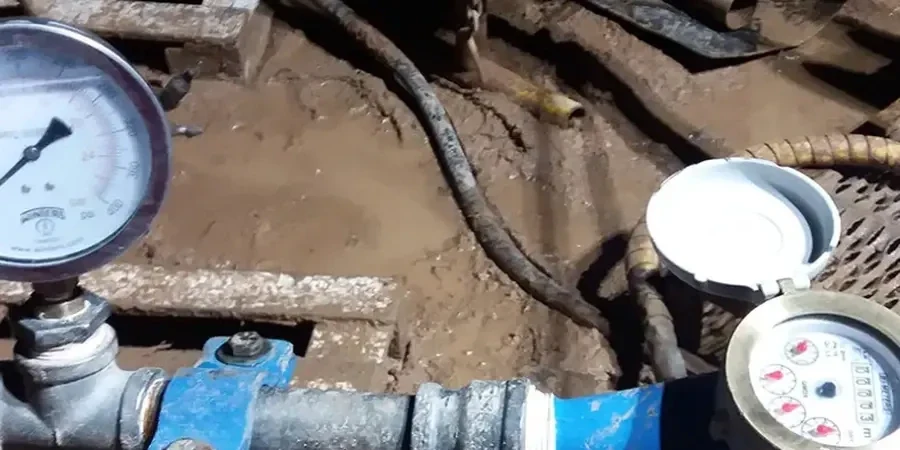
Local geotechnical context
Perth’s Mediterranean climate—long dry summers punctuated by intense winter fronts—creates a permeability testing window that matters. Groundwater levels in the superficial aquifer can swing 3 metres seasonally, and a test run in April at peak dry conditions will give a different steady-state picture than one run in August after sustained recharge. We’ve seen basement excavations in East Perth where winter inflows through Tamala Limestone solution features exceeded summer estimates by 300%, simply because the test was done at the wrong time of year. Add to that the salinity of Perth’s deeper groundwater—brackish to hypersaline east of the Gingin Scarp—and you’re dealing with density-driven flow effects that freshwater slug tests won’t capture. Testing in the right season, with the right method, and interpreting results against local hydrogeological context is what keeps dewatering plans from failing when the first big front hits in June.
Service video
Relevant standards
AS 1726-2017: Geotechnical site investigations, AS 1726.2: Subsurface investigation logging and reporting, Houlsby (1976) Lugeon test interpretation method
Related technical services
Lefranc Testing in Unconsolidated Soils
Constant and falling head tests in cased boreholes across Perth’s Bassendean Sands and alluvial deposits. We isolate specific layers to give you horizontal conductivity (Kh) values for dewatering well design, basement drainage, and infiltration basin sizing.
Lugeon Packer Testing in Rock
Pressurised water testing in fractured Tamala Limestone, granite, and dolerite. Five-stage pressure cycles identify fracture flow regimes—laminar, turbulent, dilation, or washout—critical for dam foundation assessments, grout curtain verification, and tunnel inflow prediction.
Combined Permeability and CPT Profiling
Where stratigraphy controls flow, we pair in-situ permeability tests with CPTu soundings to map pore pressure dissipation and soil behaviour type. This integrated approach is particularly effective in the Swan Coastal Plain where thin clay layers act as local aquitards.
Typical parameters
Top questions
What does a field permeability test cost in Perth?
Field permeability testing in Perth typically runs between AU$850 and AU$1,780 per test interval, depending on depth, access conditions, and whether you need a Lefranc test in soil or a Lugeon packer test in rock. A full day’s programme with multiple intervals and a NATA-accredited report generally falls in that range. Factors like remote site access, deeper boreholes requiring larger rigs, or combined CPT profiling will shift the quote toward the upper end. We provide fixed-price proposals upfront so there are no surprises once the drill crew is on site.
When should I choose a Lugeon test over a Lefranc test?
Choose the Lugeon test when you’re dealing with fractured rock—Tamala Limestone, granite, or dolerite—and need to understand how the joint network transmits water under pressure. The Lugeon uses packers to isolate a specific interval and applies staged pressures to identify the flow regime (laminar, turbulent, or dilation). The Lefranc test is for soils and soft rocks where a simple screened section in a borehole gives representative horizontal conductivity. In Perth, many sites span both conditions—sands over limestone—so we often run Lefranc in the upper 10 metres and switch to Lugeon in rock below.
How does Perth’s groundwater seasonality affect test results?
Perth’s superficial aquifer can fluctuate 2 to 3 metres between late summer (March–April) and mid-winter (July–August). A permeability test run at low groundwater levels will reflect unsaturated zone effects near the water table and can overestimate drainable porosity. We recommend testing when groundwater is closest to the level expected during construction—if you’re excavating in winter, test in winter. For critical dewatering designs, we also run tests across two seasons to capture the full range of hydraulic response, or use CPTu dissipation tests to get a pore-pressure-independent conductivity estimate.
What reporting do I get after the test?
Every field permeability programme comes with a NATA-accredited report compliant with AS 1726.2. You’ll receive interval-by-interval Lugeon values and equivalent hydraulic conductivity (K in m/s), pressure-stage plots showing flow regime interpretation, borehole completion details, and groundwater level monitoring data. Where relevant, we include correlations with CPTu or SPT data to place the permeability results in stratigraphic context. The report is structured so your dewatering or geotechnical design engineer can pull values directly into seepage models or grouting specifications without re-interpretation.