A recent infrastructure project in the Swan Coastal Plain ran into trouble when compacted limestone fill failed density testing at three consecutive lifts. The contractor was following the method specification, but the reference density they were using came from a generic Proctor curve that did not match the borrow source. Our lab re-ran a site-specific modified Proctor on the actual fill material, and the optimum moisture content came back 2.5 points higher than the assumed value. Once the field compaction target was adjusted, the lifts passed first time. Perth’s geology presents this challenge constantly: the transition from Bassendean Sand to Tamala Limestone to alluvial clays happens over short distances, and each material demands its own compaction reference. Without a proper Proctor test, you are either under-compacting and risking settlement or over-compacting and wasting fuel. Whether the project is a residential slab in Baldivis, a warehouse pad in Kewdale, or a tailings dam in the Goldfields, the Proctor test anchors every defensible earthworks specification. We run both standard and modified Proctor to AS 1289, and we routinely pair the result with a sand cone density field check so the contractor can correlate the lab target with what the roller is actually achieving on the lift.
A site-specific Proctor curve replaces assumptions with a measurable target: maximum dry density and optimum moisture content that the roller must meet on every lift.
Approach and scope
Local geotechnical context
The compaction hammer in our Perth lab is a mechanical drop-weight rig, not a hand-guided rammer, because the AS 1289 method demands precise control of drop height and blow rate. Hand compaction introduces operator variability that shifts the Proctor curve enough to fail a field density test. For Perth’s Tamala Limestone fills, the risk is even more specific: this material crushes under the modified hammer, creating fines that alter the grading during the test itself. When that happens, the lab curve no longer represents what the padfoot roller achieves in the field. The team catches this by running a companion particle-size analysis before and after compaction. Another failure mode we see regularly is testing at the wrong starting moisture content. If the first point on the curve is already above optimum, the peak gets missed entirely and the reported maximum dry density comes back low. The consequence on site is an impossible density target that the contractor chases with extra passes, wasting time and burning diesel. On large earthworks packages, getting the Proctor right on the bulk sample submitted at the start of the job saves tens of thousands in re-testing and re-compaction down the line.
Relevant standards
AS 1289.5.1.1 – Soil compaction and density tests: Determination of the dry density/moisture content relation of a soil using standard compactive effort, AS 1289.5.2.1 – Soil compaction and density tests: Determination of the dry density/moisture content relation of a soil using modified compactive effort, AS 1289.5.4.2 – Compaction control test: Assignment of maximum dry density and optimum moisture content values, AS 3798 – Guidelines on earthworks for commercial and residential developments, Main Roads WA Specification 501 – Earthworks
Related technical services
Standard Proctor (AS 1289.5.1.1)
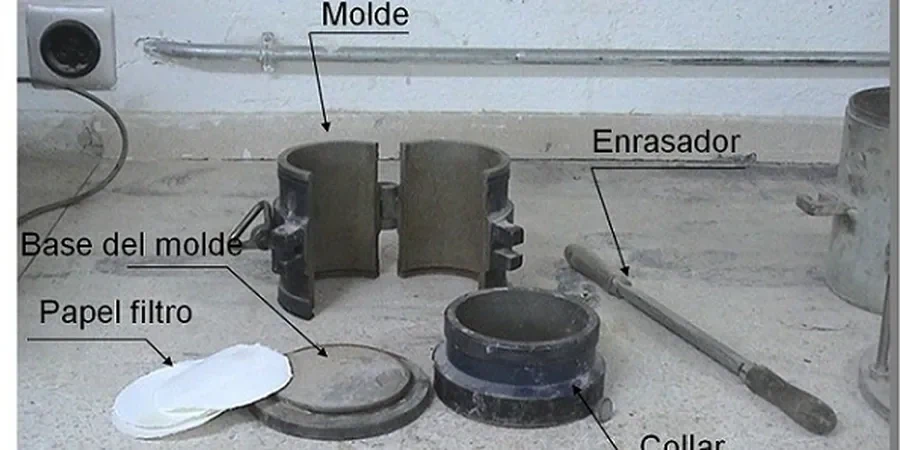
Compaction curve using 2.7 kg hammer and 300 mm drop across three layers. Typically specified for landscape fill, trench backfill, and residential earthworks under AS 3798 where structural loads are modest.
Modified Proctor (AS 1289.5.2.1)
Compaction curve using 4.9 kg hammer and 450 mm drop across five layers. Required by Main Roads WA for structural fill, road sub-base, and any engineered fill supporting footings or pavement.
Oversize correction and scalp-and-replace
When the fill contains particles larger than 19 mm or 37.5 mm, we apply the AS 1289.5.4.2 correction protocol, replacing oversize with an equal mass of minus-4.75 mm material to produce a usable field target.
Field density correlation package
Combined Proctor reference curve plus on-site sand cone or nuclear gauge testing at the same borrow source, delivering a defensible relative compaction result that satisfies Level 1 supervision under AS 3798.
Typical parameters
Top questions
What does a Proctor compaction test cost in Perth?
A single Proctor curve, standard or modified, typically costs between AU$170 and AU$290 depending on the number of points and whether oversize correction is required. Expedited turnaround may add a surcharge. Bulk pricing applies for projects needing multiple Proctor references across different borrow sources.
Which Proctor effort should I specify for a residential slab in Perth?
Most residential slabs on the Swan Coastal Plain are built on controlled fill compacted to a modified Proctor reference, especially where the foundation design relies on the fill for bearing. Standard Proctor may be accepted for non-structural fill under AS 3798, but the structural engineer will normally state the required compactive effort in the earthworks specification. When in doubt, modified Proctor provides the more conservative and widely accepted target.
How much material do you need for a Proctor test?
We require approximately 25–30 kg of representative bulk sample for a standard 105 mm mould test, and up to 50 kg if oversize correction on a 152 mm mould is anticipated. The sample must be sealed in a bag immediately after collection to preserve in-situ moisture. For Perth’s sandy soils, moisture loss happens quickly, so we recommend delivering the sample to the lab the same day or storing it in a sealed container overnight.