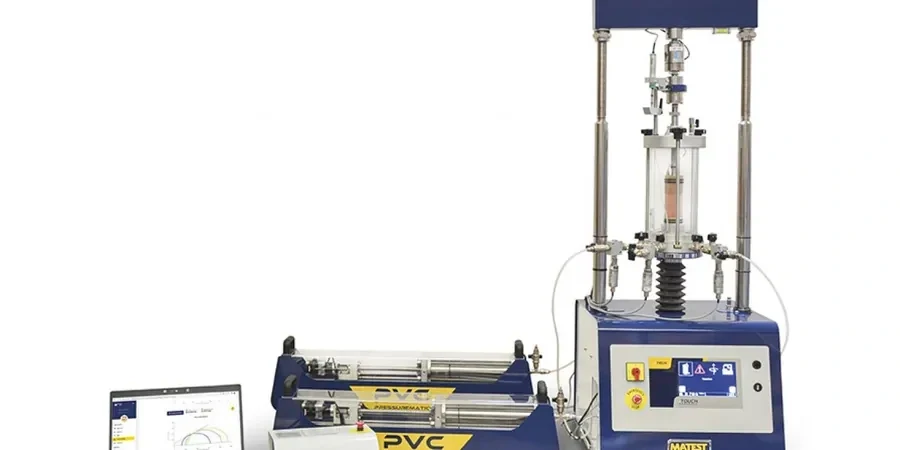
Perth's subsurface, shaped by aeolian Tamala Limestone, Bassendean Sand, and alluvial Guildford Clay, presents a layered depositional history that demands precise effective stress analysis. With foundation loads transferring through these distinct formations — often within meters of the water table — the triaxial test becomes the definitive method for extracting cohesion and friction angle values under controlled drainage conditions. Nearly 80% of Perth's coastline is backed by Quaternary dune systems, where calcareous sands behave markedly different under saturation than they appear in dry bore logs. The laboratory's NATA-accredited triaxial program, running consolidated-undrained (CU) and consolidated-drained (CD) protocols on undisturbed Shelby tube samples recovered from depths between 3 and 25 meters, provides the numerical backbone for bearing capacity calculations and slope stability assessments in cuttings along the Mitchell Freeway and Mandurah rail corridors.
A single set of CU triaxial tests on Bassendean Sand can increase the design friction angle by 4 to 6 degrees compared to SPT correlations, directly reducing concrete volumes in Perth's coastal projects.
Approach and scope
Local geotechnical context
The most costly mistake observed in Perth's coastal construction is the reliance on unconsolidated-undrained (UU) tests alone for effective stress analysis in Bassendean Sand, particularly when the water table sits within 2 meters of the ground surface during winter months. UU tests on saturated sands generate near-zero apparent cohesion and a friction angle that reflects total stress conditions — neither of which represents the drained behavior that governs long-term settlement and bearing capacity. A project in Scarborough encountered this exact issue: UU results suggested a friction angle of 31°, prompting a redesign with piled foundations, yet subsequent CD triaxial testing on the same formation returned a peak effective friction angle of 37°, making the original shallow footing scheme viable after all. The geotechnical investigation budget, already allocated, doubled because the wrong test protocol was selected at the start. AS 1726 explicitly distinguishes between short-term and long-term analysis conditions, and the choice between CU and CD protocols must align with the construction timeline and drainage characteristics of the Perth Basin sediments — a decision that requires collaboration between the drilling crew, the laboratory engineer, and the design geotechnical consultant before the first sample enters the triaxial cell.
Relevant standards
AS 1726:2017 (Geotechnical site investigations – Section 6: Laboratory testing of soils), AS 1289.6.4.1:2016 (Method for triaxial compression test — undrained with pore pressure measurement), AS 1289.6.4.2:2016 (Method for triaxial compression test — consolidated drained), AS 1289.6.5.1:1999 (Method for triaxial compression test — unconsolidated undrained), AS 1289 (Standard Test Method for Consolidated Undrained Triaxial Compression Test for Cohesive Soils)
Related technical services
CU Triaxial with Pore Pressure Measurement
Consolidated-undrained testing on Guildford Clay and alluvial silts with electronic pore pressure transducers, providing effective stress paths and Skempton pore pressure coefficient Af for excavation stability analysis.
CD Triaxial on Calcareous Sands
Drained testing at strain rates calibrated to the hydraulic conductivity of Tamala Limestone and Bassendean Sand, producing effective friction angles for direct input into PLAXIS and Slope/W models.
Multi-Stage Triaxial Testing
Three-stage CU or CD programs on a single specimen, reducing soil variability when sample recovery is limited — particularly useful in deep boreholes within the Perth CBD where Shelby tube runs are short.
Stress Path Triaxial (K0 Consolidation)
Anisotropic consolidation triaxial tests that replicate the in-situ stress history of overconsolidated Perth Basin clays, yielding stiffness parameters (E50, Eur) for settlement prediction in mat foundation design.
Typical parameters
Top questions
How long does a triaxial test program take for a Perth project?
A standard three-specimen CU triaxial suite on Guildford Clay typically requires 10 to 14 working days from sample receipt to final report. The timeline is driven by the consolidation phase, which depends on the coefficient of consolidation (cv) of the material — Perth's alluvial clays often require 24 to 48 hours per consolidation stage. CD tests on Bassendean Sand are faster, usually completing in 7 to 10 days because the higher permeability allows faster drainage during shearing. Expedited schedules are available for construction-phase testing when preliminary results are needed within 5 working days.
What sample quality is required for triaxial testing in Perth's soils?
Undisturbed Shelby tube samples of 72 mm diameter are the minimum standard for triaxial testing under AS 1289. Samples must be sealed with wax and plastic caps immediately upon extrusion, transported in foam-lined crates, and stored at 4 °C to preserve natural water content. The laboratory assesses sample disturbance using the Lunne criterion (Δe/e0 ratio) before accepting specimens for testing. Bassendean Sand samples with visible lamination loss or Tamala Limestone cores with fracture damage are typically rejected and re-sampled.
What does triaxial testing cost for a Perth geotechnical investigation?
A complete three-specimen CU triaxial suite with pore pressure measurement and NATA-endorsed reporting typically ranges from AU$2,540 to AU$4,440, depending on the number of confining pressures, the need for back-pressure saturation monitoring, and the consolidation duration. CD triaxial programs fall in a similar range but may be adjusted based on the shearing rate and specimen diameter. Multi-stage tests that reduce sample quantity requirements can offer cost efficiencies when borehole recovery is limited.